If you thought they were addictive now, just wait.
Content creators have gotten really good at optimizing their videos thanks to the hyper-competitive markets of TikTok, Instagram Reels, and YouTube. They know how to fine-tune everything in the videos, from when to cut to a new scene with the best transition to how to intonate their voice (just watch MrBeast's videos and notice his voice) to the best thumbnails (again, see MrBeast, or better yet, his How to Succeed in MrBeast Production handbook).
Companies have also gotten really good at maximizing engagement due to competition. They know user preferences better than the users themselves (see the apparent TikTok 101 algorithm document here), from colors to video order to video length to topic and so on. They exploit these preferences in the form of seemingly simple recommendations, personalization, and dark patterns.
Both the creator and company trying to maximize engagement puts the user in a precarious situation. On one hand, their time spent on the platform progressively gets more hypnotizing, putting users "in the zone" faster and for longer. And some (most?) users want this, especially those who already watch hours a day! Who wouldn't want better content? On the other hand, the user's brain gets fried, their time wasted, their attention span worsened, their lives less interesting, their opportunity cost bucket filled.
The message is clear: get out now before it's too late. The cost and difficulty of quitting will rise over time as the videos get better and more personalized, the brain craves more as a result of the improvements, everyone's sucked in more and there's a social cost of being out, and other activities lose their luster and get rusty. Videos will fall first because they're the most fun, easily accessible, multimodal, and passive of all media. Text will be the last stronghold.
Get. Out. Now.
The path forward for both short-form videos (SFV) and long-form videos (LFV) will be based on companies deeply learning individual user preferences and tweaking the videos accordingly to make them even more enticing, enjoyable, and addictive. Everyone will be watching slightly different versions of the same video—the gist will effectively be the same, but the specifics will vary. Alternatively, in a world where everyone has their own LLM, some may task their little robot friend with making their (the human's) media diet tastier; this may take the form of coordinating with the companies, e.g. "Hey YouTube, this is Bob's personal agent. Here are some patterns I've noticed about Bob and some things he's explicitly told me. Please help to improve the videos he watches so he's able to forget about his crippling anxiety and avoid working on it."
Some examples of things that may change within a video:
Colors affect emotion. Clothing; hair (so long as it doesn't obviously change a known character's appearance); items (cars, bicycles); eyes. Colors will shine brighter (1, 2) without revealing that the video was enhanced. Filters will be applied on the fly and as needed to each shot.
Meta's Segment Anything Model (SAM) 2 can easily "track an object across any video and create fun effects interactively, with as little as a single click on one frame."
Voices will become more pleasant in tone, pitch, and intonation; volumes will vary automatically as needed; wording will be better and scale to the level of the user to increase accessibility, e.g., a five-year-old will get different words than a 30-year-old or a less intelligent user versus a more intelligent user.
Spoken words may show more signs of LLM-speak and Claudese, although a) the models' idiosyncratic writing styles will likely have faded by then, at least to the point that they're no longer immediately recognizable, and b) it's difficult to tell apart people whose speaking styles have changed because they interact with LLMs and people who are reading an LLM-written script.
See also:
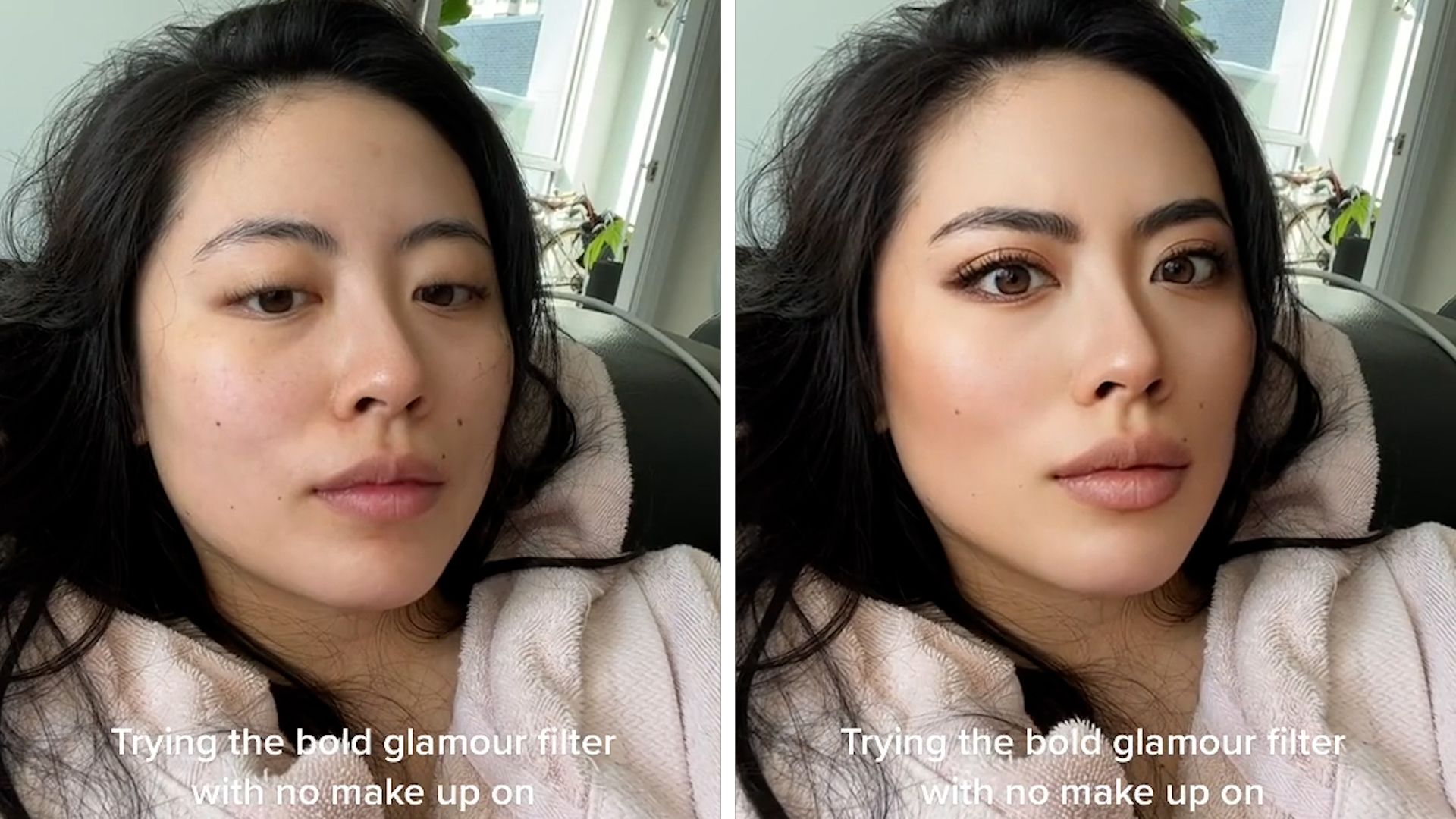
Characters will have minor improvements to their appearances, including teeth (straighter, more uniform, whiter), facial symmetry, body shape, grooming, blemish removal, clearer skin, tanner or paler skin, and stray hair removal. Everyone will be slightly hotter/prettier/sexier/friendlier/cooler without turning into a completely different person or the change being too noticeable. TikTok's Bold Glamour filter does this in real time with impressive results:
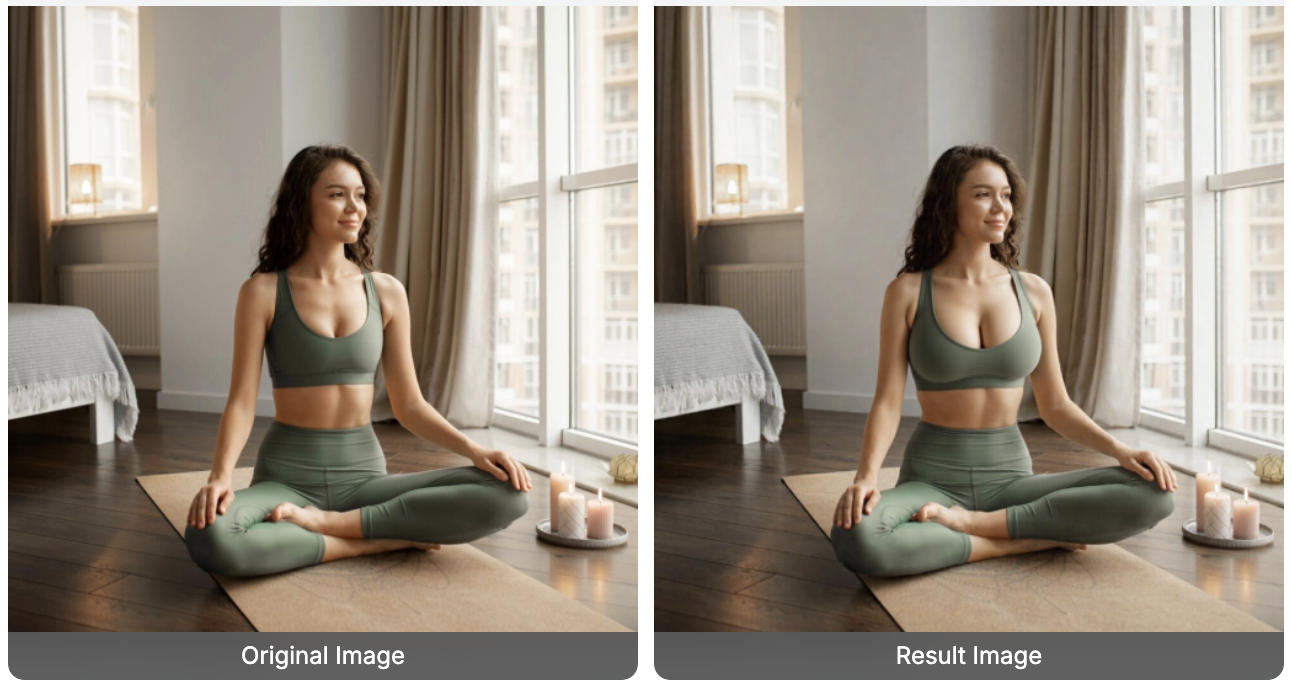
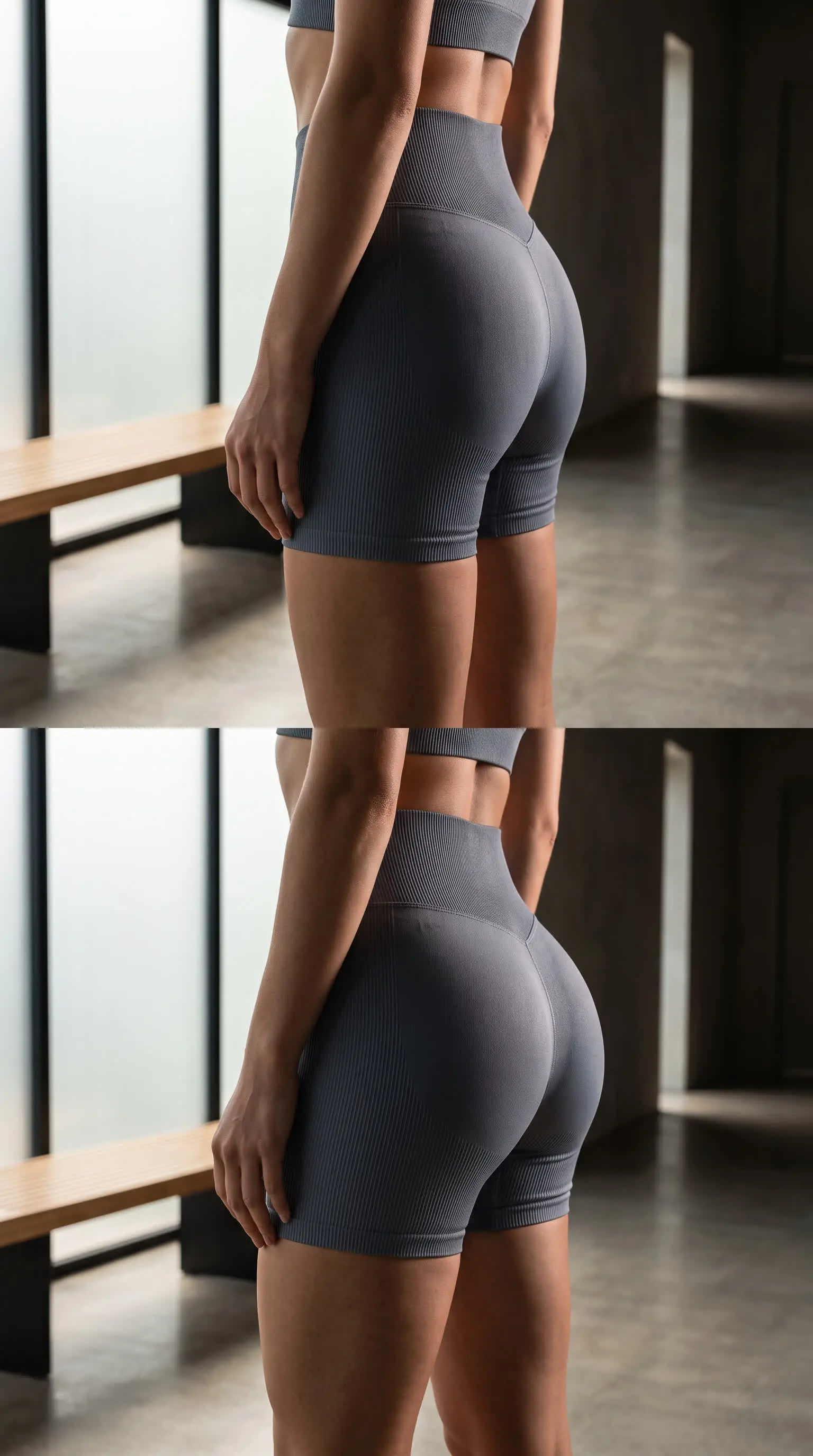
Does the female user like big biceps or a big chest on a man? How about both? Does the male user like a big butt or a tasteful amount of cleavage on a woman? How about both? Certain videos will slowly move closer to porn when and where it makes sense to. I suspect women will become more pornified than men, hence the examples below, and there's some evidence for it.
Take this random, free AI breast expansion tool and the example picture it provided—the changes are not obviously artificial (especially if you didn't have the original!), believable, and attractive:
Or this butt lift filter by ByteDance:
YouTube is already enhancing videos to "to reduce blur and noise while sharpening the image".
For videos whose sections can be moved around, the algorithm will learn the best order in which to place each section, sometimes skipping sections altogether, or at least asking the user if they want to skip with a simple "Do you want to skip this section? We are confident you will not like it." (This is less important for SFV and more important for LFV, but may still matter.) YouTube has started on this with its Jump Ahead feature.
After enough yeses and a user opt-in (or lack of opt-out...), those parts of the video will be automatically removed. This is akin to how most users trust Claude Code enough to constantly say yes, i.e., auto mode (or at least don't know what it is or how to change it...). Shortening longer videos may be a race to the bottom, though, where LFV get progressively shorter, users' attention spans shrink to match, and the videos get shorter still. 60-minute videos become 30-minute videos as users want more and more action and less and less filler, and the AIs quickly recognize this and begin aggressively trimming away the fat. User feedback will still be positive, and creators will learn that certain parts of a video are unnecessary, allowing them to not film those at all and reduce production costs.
Ad placement will be much more subtle, tasteful, and persuasive. Users may not even recognize they're being advertised to. More ads will appear in the video because why wouldn't they? The car, the clothes, the phone: everything can easily be swapped for a price, so long as the creator approves the changes (and they overwhelmingly will, probably by default with no actual review). This is already done using virtual product placement, where products are inserted into media during post-production, allowing customizability. Zero-shot methods, which can place a product without being trained on it first (hence lower cost), already get pretty solid results.
Note that the FTC requires creators to disclose ads, but disclosure rules can only do so much.
Netflix personalizes artwork to increase the likelihood of a user selecting that title. (There's also an accompanying non-technical blog post here.) Note that the technical post was written in 2017, so who knows how much better the system has gotten since then. YouTube also has a thumbnail A/B testing feature.
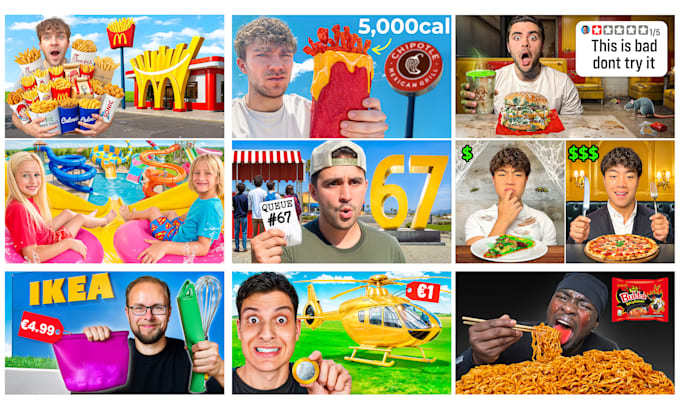
And these are just tweaks designed to make it better for the individual user. The base video itself will already be edited (by AI) to maximize expected value across the likely viewing population.
Or will the entire process be managed by AI? Will the AI generate the idea, write the script, provide feedback on the shot, edit the transitions, piece everything together, etc? Will humans actually film anything anymore? Or will prompts simply be "create a new video for me" and off the AI goes to plan, schedule, research, create (as in create an entirely AI-generated video), edit, test, finalize, and post? A/B tests will become A/B/.../Z tests as more variables can easily be iterated upon and the potential viewer base grows rapidly.
Runway's Aleph 2 can already make many of these changes:
Edit a frame the way you want. Aleph 2.0 carries that look through your video, so what you see is what you get.
Describe what you want to change — a product color, a hairstyle, a piece of clothing — and Aleph 2.0 changes only that. The background, lighting and other details stay just as they were.
In videos with multiple cuts or scene changes, Aleph 2.0 can apply your edit across relevant shots.
You can now edit clips up to 30 seconds long at 1080p. Long enough for ads, social posts and short-form content.
See also:
Generative AI (GenAI) tools enhance social media video creation by streamlining tasks such as scriptwriting, visual and audio generation, and editing. These tools enable the creation of new content, including text, images, audio, and video, with platforms like ChatGPT and MidJourney becoming increasingly popular among YouTube creators. Despite their growing adoption, knowledge of their specific use cases across the video production process remains limited. This study analyzes 274 YouTube how-to videos to explore GenAI’s role in planning, production, editing, and uploading. The findings reveal that YouTubers use GenAI to identify topics, generate scripts, create prompts, and produce visual and audio materials. Additionally, GenAI supports editing tasks like upscaling visuals and reformatting content while also suggesting titles and subtitles. Based on these findings, we discuss future directions for incorporating GenAI to support various video creation tasks.
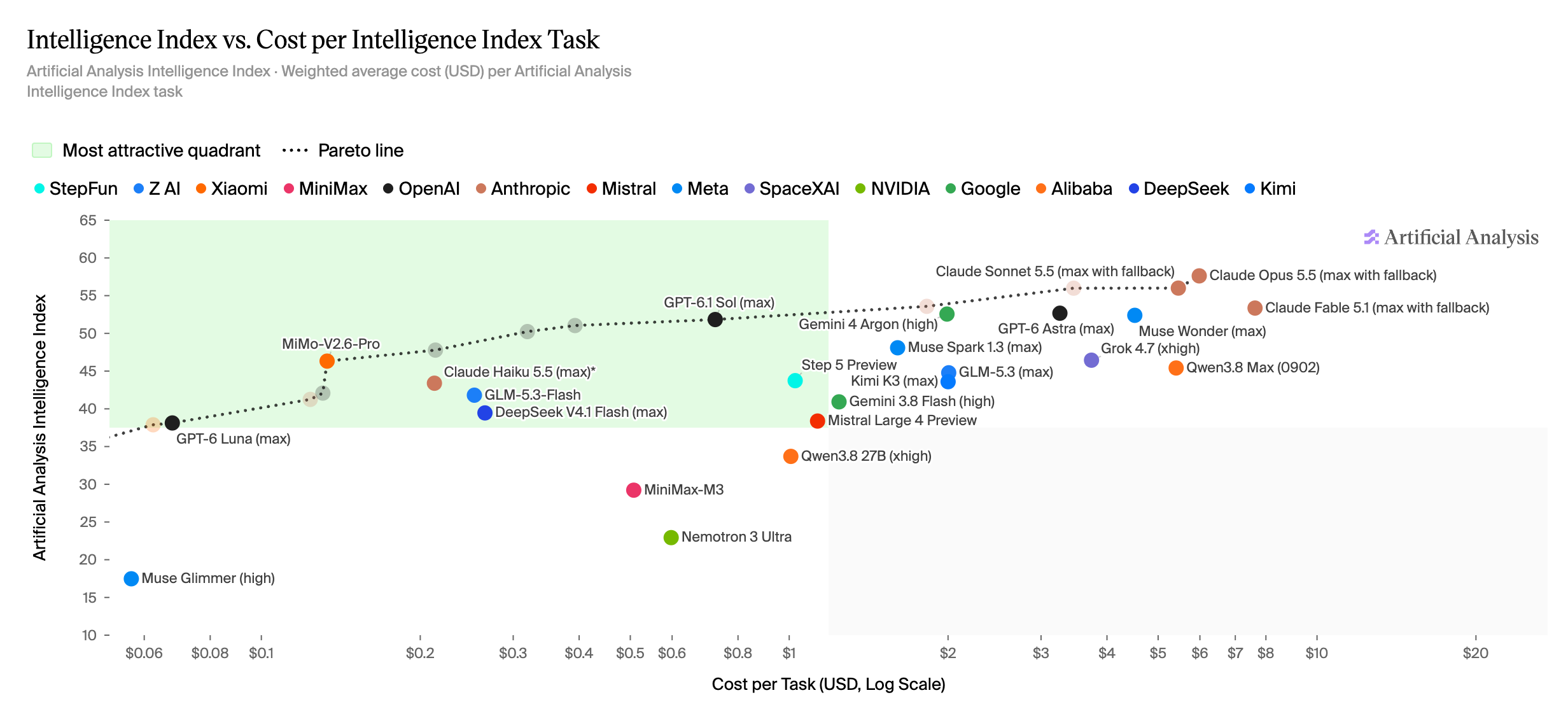
LLMs have been getting much cheaper and much better:
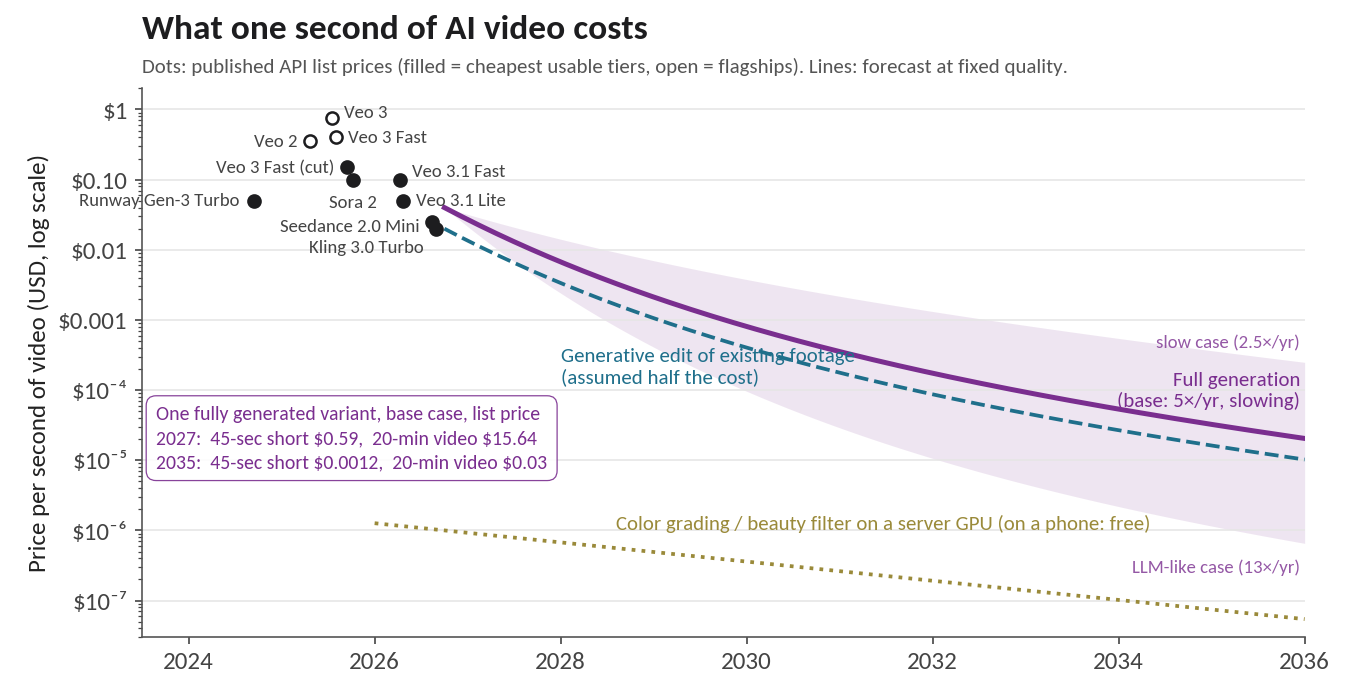
I'm unable to find an "official" equivalent chart for video generation, but had Claude Opus 5.5 help out with modeling based on LLM performance and cost metrics and what the overall cost will look like on a per-video basis.
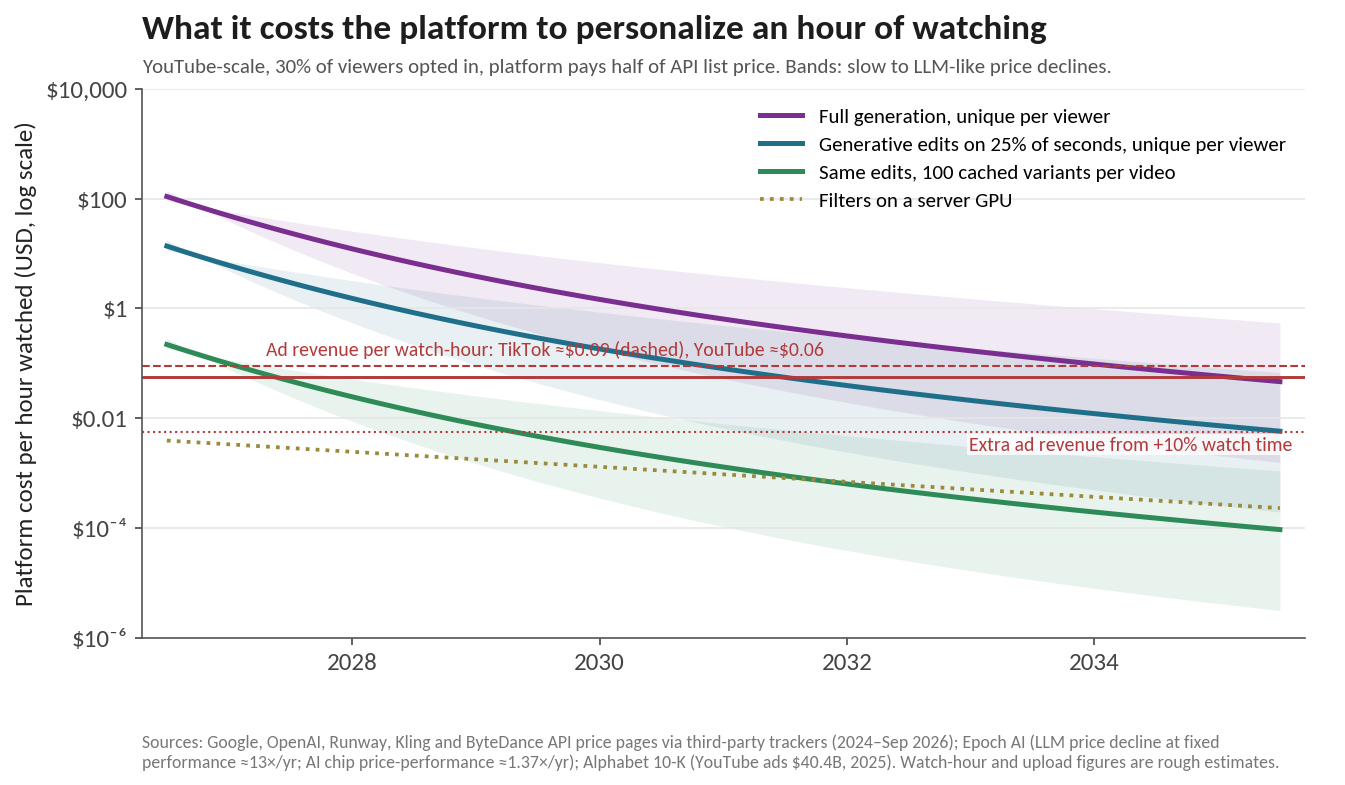
We also created a nice adjustable model so you can play with the assumptions yourself:
Anchored to ~$0.04 per second for cheap, decent full generation via API in October 2026. Ad revenue, users and watch time are held at 2025 levels. YouTube: ~2B hours watched and ~720k hours uploaded per day (rough), $40.4B ad revenue. TikTok: ~1B hours watched, ~330k hours uploaded, ~$33B ad revenue.
The incentives are aligned across all three groups:
The evidence is already there with the tools that companies have put out and the creator adoption rate.
Delete video apps from phones: TikTok, YouTube, Instagram, Twitter, Facebook, Snapchat. Web-only access from now on.
Set time limits or straight-up blocks on each that are difficult to bypass. See Password Locker for locking down passwords behind a customizable wall. See Cold Turkey for locking down website access behind a customizable wall.
Politely decline to watch any videos that are sent or shown to you.
Develop repulsion at the constant switching of sound and volume and colors and scenery and angles that SFVs have.
Develop an identity around being a person who doesn't watch videos. Encourage others to do the same.